Pages

Sunday, June 4, 2017

The advantage of a dealership service center versus an after market shop.

 
Pictures of an N63 engine with bank 2 cylinder head removed. Not an easy job. A dealer will get this done right.

Same engine from the front. Very complex wiring and hose layout that needs to be exactly where it was before it came apart. Hydraulic table being used to drop engine from underneath.

       I've seen this so many times. I go online out of curiosity and search for forums and find many people that refer to the dealership as the "stealership" referring to how expensive they are. Believe me, I know that repairs and maintenance on luxury vehicles can get very expensive, but like anything else, you are paying for what you are getting. Let's compare for example a simple oil change. A dealer might charge you $100 for an oil change on your BMW. For this price you have a certified, experienced automotive technician using factory original parts performing the service with the correct factory recommended engine oil, resetting you CBS (service interval) data correctly and performing an inspection on your vehicle. The technician working on your car knows all the details to be able to perform the service correctly and efficiently. He knows how to top off the fluids and has the correct fluids that your car needs. He also knows what key areas to inspect on your particular model to see if parts have failed, like engine gaskets, suspension components, etc. You would then get an estimate for repairs to be performed by this experienced technician with original parts and get a warranty on the parts and the labor. The repairs would be done efficiently and correctly. You would be waiting in a nice facility with TV, internet, and sometimes free food. By contrast, I have heard of people who have taken their BMW to an aftermarket shop or quick lube place, paid MORE than what the dealer charges to perform an oil change, seen time and time again how their engine oil filters don't flow oil properly and have seen some just come apart when you change them out because they don't hold up, and can cause issues with the engine. I have seen time and time again how these places strip the drain plug and damage a $1000 oil pan because they probably used a damn impact gun to put the plug back in. And after all of that not check tire pressures or fluids on the car and not even reset the service indicator because they just don't know how to.
         That was just an example of an oil change. I have seen so many repairs performed by aftermarket shops. I would say about 10-15% of them might know what they are doing, but most of them don't. Of course to the untrained eye of the customer everything might be fine and the car runs again, but we can spot the shitty workmanship right away. Hoses and wires routed the wrong way that will eventually cause issues due to rubbing, parts not installed correctly, parts getting broken trying to replace other parts, parts completely missing. Parts can break while you are working on a car. It's normal. You might be trying to change a thermostat and the coolant hose that attaches to it can just crack. This is normal wear and tear of the parts due to heating and cool down cycles or just because of the age of the vehicle. The difference is that if that same hose breaks at the dealership you would get a factory replacement hose, not some aftermarket shop trying to use a hose clamp, duct tape and bubble gum to try to put it back together. We know where everything goes and how to route wires correctly, and if we don't remember we can just go around the shop and look at another one of the same exact cars and see how everything goes back together or we can ask someone else that might know.  The point is that your car would go back together correctly and safely. We can foresee potential problems with repairs and warn the customer before it happens. We know improper repairs could leave a customer stranded and that is unacceptable. We get the job done right (most of the time at least).
        And now for the big one, DIAGNOSTICS. You might be days looking online and searching on forums for what's wrong with you car. It might be something simple or complicated. It may happen a lot or intermittently. No matter what the situation is, I believe the best people to diagnose you car is the dealership. We have all the information we need to properly diagnose a vehicle. We have the proper tools to test and perform repairs. We have the correct parts and we have the correct software. I will do another post detailing the diagnostic process in more detail, but please believe me when I say NOBODY can diagnose your BMW like BMW dealer technician.
         Another big thing to consider is time. A dealer will try to get you car done as soon as possible, usually within a few days depending on the complexity of the repairs, while independents will usually take longer. Just ordering and getting the parts they need might take them a few days. So if time is essential, like for example if that is the only car you have to drive and cannot afford being without it for a week and a half waiting for a dumb ass to figure out what's wrong with your car and then try to fix it, you might want to take it to the dealership.  I know some people may have had bad experiences at the dealership, and maybe their issue was particularly hard to figure out, but I bet if you took that same car to an independent it would have been way worse. I know of many cars that have come to us from so called independent shops specializing in European cars because they couldn't fix it and we have figured it out in a matter of hours.
        I know repairs are expensive, and a lot of times the parts alone are ridiculously overpriced, but if you can afford the dealer prices they are definitely worth it. Why have someone else waste you time and money experimenting with your car when you can get it fixed quickly and correctly and be back on the road in your ultimate driving machine.

               N62 engine after being removed from vehicle. It still has wiring harnesses, hoses, etc.


                                  N62 engine stripped down to block, pistons and crank. Only a
                                               professional should attempt this type of work.

How do mechanics get paid, and how does this influence your wallet.

Most people get paid hourly. You work 8 hours a day and you get paid for those 8 hours. Well, most mechanics don't get paid like that. It's a little bit more complex. Most mechanics, especially at dealerships, get paid by a system called flat rate. Basically you do one job and you get paid a specific amount of time for doing it no matter how long it takes. This amount of time is called a flat rate unit, or FRU. Usually one hour of time is divided into 10 FRUs.  So lets say you go to the dealership to get your oil changed. You are billed a specific amount of money which includes parts, labor, shop fees, etc. Out of that money, the technician would get paid 3 FRU for example. That would be about 1/3 rd of an hour, or about 23 minutes. So the technician will get paid 23 minutes to go find your car, pull it in the shop, place it on the lift, request and get the parts, make sure the parts are correct, perform the oil change and usually perform a vehicle inspection, fill tires and fluids, etc. Then clean the interior, test drive the car and park it outside. Then fill out the stories on the computer to close the lines on the repair order and fill out the inspection check lists, etc. and get ready for the next car. So lets say that same tech performs 3 oil changes, that would be about one hour at whatever his hourly rate is. If he gets paid $20 an hour, then after 3 oil changes he would have made about $20. 
         This system can be either good or bad, depending on where you work and how fast you are. If you work at a place that doesn't have a lot of volume, then a technician may be sitting down for half the day, even if he spent 8 hours at the dealer, and only make a few hours since there's no work to do. Now, if you work at a place with a lot of cars then you might want to stay late to work on as many cars as you can to make all the money you can. The more work you do the more you get paid. Also, if you're a very fast person or know how to do a job quicker than however much it pays you will end up making more hours than what you spend at work, so it's totally normal to work 45 hours in a week and actually make 60 hours of pay. So obviously, a tech is going to try to make the most FRUs possible at any time. How does this get accomplished? That's the part that's going to affect the customer. 
         Manufacturer's have their own specific warranty labor times for the jobs that are performed. Let's say replacing a water pump pays 1 hour. When a customer is paying instead of warranty it is normal to multiply the warranty time times 1.25 or 1.5, etc depending on the particular dealership. So let's say a tech has to do a water pump. He might get tempted to do it so fast that he get's sloppy, careless, cuts too many corners, does the job improperly, doesn't check his work, doesn't clean the area after working on the car n order to finish the car and move on. Or if it's customer pay he might be tempted to adjust the FRU times in his favor and add a couple of extra FRUs in there for his own sake. Both situations in my opinion are not acceptable. A customer should get the same price for the same job and have the same quality of work performed every time. But this happens every single day. Sometimes calculating the FRU times might get more complicated if various repairs overlap, meaning repairs that are in the same area or related to another. For example, if you're doing a water pump and the hoses that are connected to the water pump normally you wouldn't charge the customer separately for both, since you already removed the same components to get to that area. You would charge for the water pump and add accordingly to finish the replacement of the hoses instead of adding the complete amount as if you were replacing the hoses separately. This is where again a tech might find himself tempted to charge for both things as if they were separate to make more money. Also the service advisers get paid basically on commission from what they sell, so they could potentially bump up the FRU estimate to make more money for them and the technician too. On the other hand, if you're a good customer the tech and adviser might agree to charge  the customer less to help them out and make them happy. Most dealers are well managed and stuff like this doesn't happen a lot, but it does explain why if 3 people call in for an estimate on the same job they might get 3 different prices. 
         Most techs at a dealership level have a high level of pride in their work and will not try to rip off customers, and the ones that do often get reprimanded or fired. Some techs are super fast and have really good mechanical abilities and can perform excellent quality clean repairs faster than most other people, while others may take twice as long to do the same thing. It really does depend on the individual. Usually the guy who is doing diagnostic work will be slower because they think too much about what is going on, while the guy that does the heavy line (engine work, transmission work, etc) will be faster, but can't diagnose things as well as the diagnostic guys. The good thing is that at a dealership the techs will talk to each other when they have questions and share their knowledge and can usually figure stuff out better than any independent shop out there. And overall, even the guy that is being sloppy, or way too fast, will still make better repairs than any independent would due to their knowledge and experience of working on the same cars every day. 
         So in conclusion, flat rate can be brutal or it can be great depending on where you work. My advice is to get to know your service adviser and develop a good relationship with them. Don't be afraid to ask questions if you have any. An honest adviser will usually have a good explanation for you or will ask the tech to explain the repairs if it's too complicated for them to understand. If you have the option shop around, call multiple dealers and ask for a price on the same repairs. Maybe you can save a few hundred dollars like that. And remember that out of the $100 plus dollars an hour that the dealership is charging, only about 20 to 25 percent of that is for the technician, so please don't think the mechanics are trying to rip you off. It's just the price of the dealer's having to pay techs, adviser's, cleaning employees, warranty department, management, payroll, etc. 

Wednesday, May 10, 2017


On BMW V8 engines the valve cover gaskets are a tremendous pain in the ass. At least on the N62 and newer engines. I would NOT attempt this at home. There are many specialty tools needed that most people don't have, and you could get yourself in a bind if you break something. Also, the upper timing case covers need to be resealed when you do the valve cover gaskets. These can add to the headaches. The N62 has many things that make it a pain in the ass. There are small torx bolts on top that like to strip. The E60 and E63 need to have the engine jacked up on the passenger side to be able to remove the rear ignition coil (on cylinder 4) before the bank 1 valve cover is removed. The gasket itself turns into hard plastic and sticks to the cylinder head, making it really hard to separate the valve cover gasket from the cylinder head. The spark plug tubes also contribute to this and make removing the valve cover from the cylinder head very difficult. Once you have the valve cover loose it's still a pain in the ass to maneuver it to remove it from the engine. If you force the valve cover too much at an angle you can break the eccentric shaft sensor on the back of the head. Those sensors are about $500. Once you have the valve cover out, you need to take the timing case covers off. On the driver's side (bank 2) you need to remove the alternator to be able to do it, and the vacuum pump on the passenger side, which requires skill to put back on. Oh, and you need a new one of those pumps too since they are notorious for leaking. The pump is about $600, but you can't buy the o ring that causes the leak. Then you need to replace the vacuum hose that goes to the front of the vacuum pump. It gets brittle, and once you remove it to replace the vacuum pump it will not go back on and stay there. It will break off and cause the engine to sound like a turkey. This job, to be done right, requires a lot of skill and patience. If you need this done make sure you get someone that knows what they're doing.

Monday, February 6, 2017

BMW engine oil leaks


   Another big Achilles's heel for BMW engines is oil leaks. There are too many to describe in detail in just one post, so I will do many different ones to explain them more in dept and explain their consequences. I will at least mention the most common engine oil leaks, which I will describe later in further detail. Inline 6 cylinder engines usually leak from the valve cover gasket, oil filter housing gasket and the engine oil pan gasket. V8 engines leak from valve cover gaskets, upper timing case cover gaskets, vacuum pump, alternator bracket gaskets, upper and lower oil pan gaskets. The V8 also leak from the transmission mechatronic sealing sleeve and transmission oil pan gasket. One thing's for sure, BMWs leak much more in hot climate. I've seen many cars from the north that don't leak, but then they are very rusty underneath from the road salt, making them harder to work on.  Depending on which one it is, the gaskets are not that expensive. The repair price is mostly the labor. If you own or are thinking of buying a BMW in hot climate, get it checked for oil leaks. There is a high chance of there being one, or possibly more than one, and it can get very expensive, especially on a V8 engine. It is usually recommended to sta rt from the top of the engine if there are multiple oil leaks and clean everything, then recheck later on in case there is an additional leak. I will say that the guys at the dealer do an excellent job compared to most people out there, but if you can't afford dealer prices make sure you go to a reputable, knowledgeable technician. They will know what to look for in a BMW engine, what the signs of each leak are and how to fix them in the best sequence possible. BMWs are awesome cars with highly sophisticated engines, and it takes a knowledgeable technician to do the job, especially in later model engines. I've seen so many engines end up messed up due to some unknowing mechanic going at it at an independent shop without the proper tools and without knowing what they are getting themselves into. Leave this work to the experts. Your engine
depends on it.


Thursday, July 23, 2015

N63 High Pressure Fuel Pump Recall

Big surprise, the N63 engine has a recall. This time it involves the high pressure fuel pumps. These engines take the 5 bar (about 75 psi) of fuel pressure from the fuel pump inside the fuel tank and turn it into around 50 bar (735 psi) of pressure to operate the high pressure fuel injectors. I really haven't seen many of these pumps fail, though. I have probably replaced only about 3 of 4 of them in the time the N63 has been out. Regardless, they apparently fail, so we are now replacing them. The recall is not for all the N63 engines. It's for vehicles produced from January 1, 2011 to December 1, 2011. The parts, at least where I work, are already available. I did one of these recalls last week. The pumps are really easy to replace and pay well.


 That round thing with the metal lines going into it is one of the high pressure pumps. They are located on the top section of the valve cover, above the first two ignition coils.They have one electrical connector, two fuel lines, and two screws that hold them on.
  
Here is the view of the pump from the top (left pic) and side view (right). The spring is pushed up and down by the exhaust camshaft, which drives the internal pump mechanism and turns the low pressure into high pressure. So there you have it. If you have a BMW with an N63 produced on 2011, call your service advisor and see if you need to have it done.

Friday, June 26, 2015

BMW Ignition Coil Problems

BMW Ignition Coil Problems
When I first started as a BMW tech, there were pretty much two engines out there in practically every car, except the M cars, of course. There was the N62 and the M54. So many cars with the same engines. This is how we get so good at fixing them. It's the same problems in most of the cars so we know what to look for and what we need to do to fix it. Anyway, one of the big problems that these M54 engines had was the ignition coils. They used to fail all the time, and at one point BMW had a huge recall (about 500k cars) to replace all the coils on the 6 cylinder engines. If they weren't replaced they would swell up, short out internally and damage the DME (engine computer).
               
Here are two views of a typical BMW ignition coil. This is what makes the spark plugs fire. There are not spark plug wires. The DME controls these directly, and since each spark plug gets a whole coil all to itself, it can fire the spark plugs more effectively.
The only bad thing is that more than a decade later, these are still going bad all the time. The N51, N52, N52TU (basically the same engine) all use these coils, and for some reason they fail. Now for some very weird reason, the same coil in an N54 or N63 does not fail. Maybe because of the increased torque, somehow it causes less stress on them. One thing's for sure, when they go bad you'll feel it. They can fail completely, in which case the engine will feel like it's hopping inside the engine bay. Or they can fail under a load, which means when you're doing hard acceleration or trying to accelerate at a high speed (45-50 mph) on top gear. At this point you'll feel the engine feel like it's intermittently bumping/ stopping for a split second.
To make a long story short, these coils fail so much that BMW recently published a service bulletin saying that under certain circumstances, if a car comes in with a bad coil, we now need to replace all 6 coils, not just the one that failed, with an improved coil made by delphi. They are very easy to replace, by the way.

BMW N63 Valve Stem Seals

BMW N63 Valve Stem Seals
I remember back in the day, probably around 2008, when this guy came in with an E53 X5 with an N62 engine complaining about smoke from the tail pipe. We had never seen this before, so we checked the car the first time and couldn't find anything wrong with it so we let the car go. The guy came back a week later, insisting that his car was smoking from the tail pipe, and told us to let it idle for 15 minutes. We did that, and sure enough, there was smoke coming from the tail pipes. After checking a lot of stuff like crankcase vent valves and  valve covers we figured out that the valve stem seals were leaking. After that, we started seeing a lot of these engines smoking from the exhaust at around 75,000 miles and up. Some were not too bad, and some looked like mosquito trucks.
After so many years of seeing these seals leak, the new N63 engine came out. BMW never addressed the issue with the N62, but we figured that for the new N63 engine there would be a design change to improve this flaw. Well guess what, the N63 uses the same damn part number for the valve stem seals in both engines and now the N63 is smoking too. When you have smoke from the tail pipe from worn valve stem seals, this means that you're burning the engine oil inside the combustion chamber. All engines consume some oil, but these burn a LOT of oil when they are smoking, and you end up topping off the engine oil frequently. BMW now states that it's normal for these turbo engines to consume about a liter of oil every 750 miles. In my opinion that's really high, but then again I'm not an engineer. I just haven't seen a properly running N63 burn that much oil. It also doesn't help that the turbos sometimes start to leak and can also cause a lot of oil burning, or make the situation worse combined with the valve stem seals. BMW finally caught on and decided to address the situation. They designed an improved valve stem seal, which is now green in color, instead of the old orange/red ones. Hopefully these will last longer. They also have a newer way to replace the seals without having to remove the engine or the cylinder heads from the vehicle. I got one of these smoking N63 engines a few months ago, so I decided to take some pictures to share the repair here.
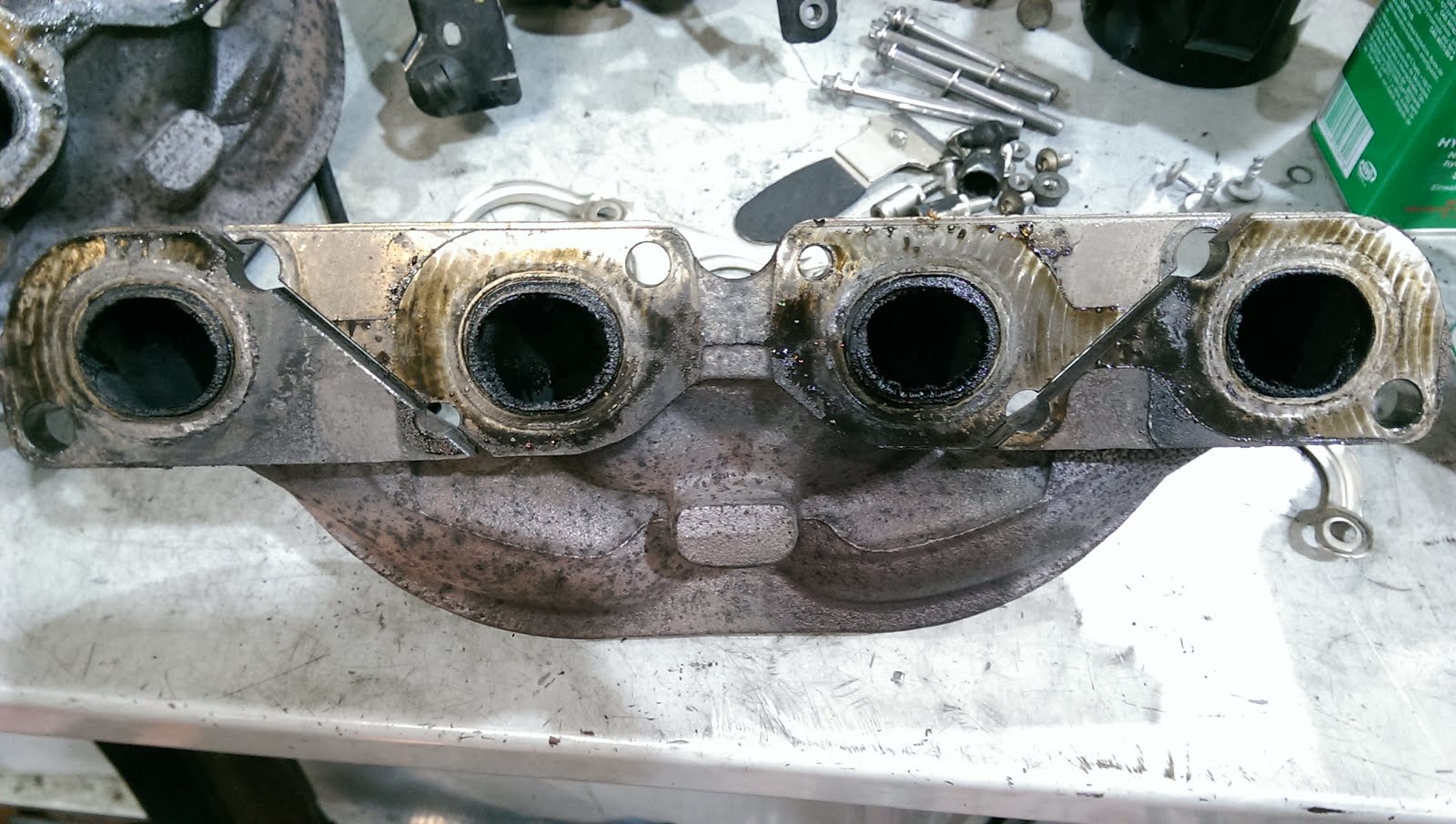
I had to check to make sure that the seals were really leaking, so I removed the turbos and the exhaust manifolds to inspect the valves.
N63 with turbos and exhaust manifolds removed
This is what I found:


On the left picture you can see the oil had passed through the seals and had entered the intake port. The right picture is of the intake manifold. The oil had been collecting there and also on the intake valves and ports of the cylinder head. After this was confirmed I proceeded with the repair.
On the newer F series platform (F01, F02, F10, F06, F07) the engine is usually not removed from the top. It is lowered, with the transmission and front sub frame on a hydraulic table. The drive shaft, power steering, coolant hoses, fuel lines, etc. are disconnected from the engine and transmission. Then the table is placed under the car and is jacked up. The sub frame and transmission bolts are removed and the complete engine, trans and front sub frame are lowered from the chassis.The vehicle stays up on the lift.

N63 engine on hydraulic table

After this, the real fun begins. There is a newer way to do this job, which consists of taking the camshafts off and replacing the valve stem seals with the engine and cylinder heads in the car, but when I did this one, the tools to do it this way did not exist, and I had to do it the old way, which is to remove the cylinder heads and place them on a special jig, and then remove the camshafts, lifters, valve springs and finally replace the damn valve stem seals. It sounds like a lot of work because IT IS a lot of work.


     On the top picture, we have the bank 2 cylinder head with cover, injectors and high pressure pump. on the bottom picture, the same cylinder head with the valve cover off. Camshafts and vanos units are still installed.


Same cylinder head on the top picture with vanos and camshafts removed. Bottom picture shows part of the engine block after removing the bank 2 cylinder head.


Close-up picture of one of the cylinders and piston.

After the cylinder head is removed, I also removed the fuel injectors so I could place it on the cylinder head jig to remove the valve springs and seals.


Once the cylinder head is mounted here, the valves are held in place from underneath so the valve spring can be pushed down, and the keepers can be removed. Then the spring can come out to access the valve stem seal.


The spring is compressed by the special tool, exposing the keepers for removal.


This is a picture of the original (red) valve stem seal.


This is a picture of the improved (green) valve stem seal.

Comparison of the old vs new seal. You can clearly tell the old one on top is wider and bowed out compared to the new one on the bottom. 


Old seal on left vs new seal on right installed on valve.

After all the dis assembly, I finally get to the valve stem seals. You can see the old one (reddish color) is mushroomed out, causing it to leak and let the oil go through. The new (green) seal fits much tighter around the valve stem, creating a better seal.


Also, since the seals had been leaking for a while, the intake ports and valves were full of carbon so I took the opportunity to clean these to increase airflow.


Valve springs on the back of the pictures. The valves on the left side of the picture are the ones I had already cleaned, compared to the dirty ones on the right.
After cleaning all the valves and ports and replacing the valve stem seals I re assembled the engine and reinstalled it in the car. It ran great after the repairs.


Thursday, June 11, 2015

Stalling E90 M3

S65 engine without intake manifold

Today was one of those days that I was really exited to work on a car. It was an 2011 M3 that intermittently stalls. Another tech scanned it and there were no faults, so they did the usual procedure, which is to reprogram the car with the latest software…the magical fix for everything. Only that this time, when the guy who takes the cars on extended test drives for cases like this drove the vehicle, the engine died twice on him. Sooo, I guess that means it wasn’t the software, huh.
The next step was to ship the car over to me for diagnosis. Curiously enough, another 2011 M3 with intermittent stalling came in the next day, also with no faults stored. Fun times! After a lot of thinking what the fuck could be happening with this thing and theorizing and talking to my team mates on what could be intermittently causing this shit to happen, I decided the best way to go was to chase whatever controls the idle air system. I looked at the training manual and found there is one common controlling device for the idle on both banks, so this would make the most sense, then I noticed the tank vent valve vents into the idle air valve. If the valve stays stuck and vents when its not supposed to, it could cause erratic idling. There are so many things that could be causing this, and the more you think about it, the crazier stuff you can come up with. This is when I need to remember to KISS (keep it simples, stupid) and try the easy stuff first.
So I went ahead and replaced the idle valve and tank vent valve, and so far I haven't heard anything again from the car. It was worth attempting to do the repair after analyzing what may have been going ok. There are many people out there that have the same thing happening to them on the s65 and s85 engines.  I would definitely recommend starting with the idle valve/ purge valves. The s85 has two of each. It's expensive, but if you have these cars you need to be able to pay to play.
Throttle valves, throttle actuators and idle air valve piping
Idle air valve and piping that goes under throttle valves.

Diesel Power = Torn Harmonic Balancer

On the left is the original harmonic balancer. On the right is the redesigned one

BMW used to have diesel engines in the USA, until stringent emission laws prevented them from bringing them here anymore. They continued to have them in different parts of the world, and after a lot of work to meet emission regulations, they managed to bring the 6 cylinder diesel engine back to the USA in the E90 and the E70, and let me tell you, they are really powerful. They have so much torque that we've seen a few of the E90s break the harmonic balancer (the big pulley in front of the crankshaft that is used to drive the belt and accessories). When this happens the engine runs but you have no power steering, A/C or alternator to charge the battery. Also, you can smell rubber burning pretty bad. Luckily I've only seen a few of them, and apparently the problem has been corrected by a re designed, beefier harmonic balancer. Now people can enjoy the gobs of low end torque without worrying.....at least about THIS issue. BMW has learned a lot about diesel engines in the USA now and have made drastic improvements on the newer diesels and have now released the 4 cylinder diesels in the USA too. More to come on diesel repairs soon!
You can see on the old style how the rubber is ripped around the center hub. The hub will spin, but not the rest of the balancer.
New balancer has a lot more rubber to prevent reoccurrence of the issue.

N54 Engine Air Leak

Valve cover, near the oil filler cap
Engines today have a very complex system to manage what goes inside them, as far as air and gas goes. They have various sensors that the engine computer (DME) use to regulate how much gas the injectors are going to inject into the cylinders depending on how much air is going into the cylinders. The DME is smart enough to make adjustments if the mixture is a little off, but if the mixture is off too much, then the engine is gonna run like crap. This is the valve cover of an N54 engine (the plastic cover that sits on top of the engine). We've seen a few of these engines that come in running bad, with lean mixture faults (there's too much air going into the engine, so the DME can't keep up with the amount of gas that is needed for the engine to run right). When we do a smoke test we've found a common spot on these engines that are leaking air. The valve cover cracks at this specific spot. It's easy to spot, and it's the first place to look when you have these faults.
Can you spot the crack?
It's right next to that fuel injector line. That slight crack causes havoc.


BMW N63 Customer Care Package

BMW N63 Customer Care Package
20130322_110120
N63 engine on E70 X5

20130322_095622
N63 without cover

Many of you might be wondering what exactly is the N63 customer care package, and why this is being done. First of all, this is not a recall. I don’t think any of the components being replaced would leave anyone stranded if they fail. I believe BMW is doing this to improve the engine’s reliability and customer’s experience and expectations. As part of the customer care package, the fuel injectors, vacuum pump, and low pressure fuel sensor are checked to see if they have already been replaced with an improved part. If it has, then there is no need to replace them again. If they have not been replaced with the improved parts, they will get replaced. Besides these parts, all engines get new mass airflow sensors (I have never seen one fail), crankcase vent pipes (the plastic would crack all the time, but they were redesigned to withstand more heat), and seals for the intake pipe going into the turbo charger(they get hard as a rock and don’t seal right, but the material was redesigned). The second part of the customer care package is to check the timing chain for excessive wear through a test plan that actuates the vanos units to their limit positions and checks if the limits are too far off, indicating that the chain has stretched. I think only about 5-10% of engines need the timing chain done. Besides this, the second part of the CCP requires an engine oil change and programming to reduce the oil service interval to one year or 10,000 miles.
As BMW’s new reverse flow twin turbo V8, there are some problems that are going to arise, as is the case with any new design. When the twin turbo n54 came out, it had horrible problems with the high pressure fuel pumps, low pressure fuel sensors and high pressure fuel injectors. Well, the same fuel injectors and low fuel pressure sensors are used in the N63 engine, plus the reverse flow cylinder head design causes the injectors to be exposed to higher temperatures, which causes them to fail. Some of the early N63 injectors were failing so badly that they would fill the cylinders up with fuel, causing the engine to hydro lock. In all the time that these engines have been out, I have yet to see one of these come into the shop. It’s not as frequent as some people make it out to be. Usually the engines would run rough and misfire, the check engine light would come on and the cars would come to the dealer, and we would end up replacing all the injectors. In 2013 the injectors were redesign to withstand more heat, and after the original injectors were replaced with the improved new ones, we would rarely see them fail again. The low pressure sensors do go bad frequently, but you can’t even tell the difference in how the engine runs, and most of the time it wont even set the check engine light. The sensor has been redesigned also, so now they don’t fail as often.
20130315_114600
OK injector on the left, fouled injector on the right.

Overall I think BMW did a great job in stepping up to the plate and taking care of their customers and hopefully this will improve the company’s reputation in terms of reliability. All engines, not matter what company designs it, are going to have issues. The more technologically advanced an engine is, the more difficult it is to make it reliable, yet BMW engineers always find a way to make it happen. The N63TU is more advanced, powerful and reliable than the N63. The same goes for the N55 compared to the N54 (in my opinion). So if you have a BMW with an N63, get the CCP done and go enjoy your ultimate driving machine.

BMW Z4 E89 PT CAN Bus Issues


Wiring rubbing on sharp edge of DSC unit block near top center of picture

Today I got all happy because when I asked my team leader for work, he told me he had another difficult car. They had scanned it earlier and found about 100 CAN bus related communication faults. Most techs hate this kind of problem because it's really hard to fix. A CAN bus is how some of the control units in a car talk to each other and share information. For example, the DSC control unit will take the signal from the wheel speed sensors and send it over the CAN bus to the transmission so it know what gear to be in, and will also send the information to the instrument cluster to display the vehicle speed in the speedometer. The bus itself is usually two intertwined wires that connect to a certain group of control units. There’s a PT CAN, which lets all the power train control units talk to each other, K CAN bus for the control units of the vehicle’s interior, and other buses for sub systems. It’s hard to find these communication issues because they are usually intermittent and everything is working fine when you go to check it. I was wondering what the hell to do with all the faults. I started looking at all of them and the amount of times they had happened. I found they were mostly related to the DSC control unit, which controls the stability and ABS of the car, among other things. I thought to start with the control unit itself, but I decided to inspect the big wiring connector in case there was anything stupid going on, or maybe mouse damage (when rats make nests inside the engine bay and chew through wires, causing problems). When I was looking at the connector I noticed the wiring harness was rubbing up against the sharp metal edge of the DSC unit. When I looked more closely I found it had cut through the harness and was slightly cutting through the PT CAN wire, causing it to short and mess up communication between the control units. I fixed it and cleared the faults. Drove the car and rechecked faults. Car was fixed. I couldn’t believe how lucky I was to have found that so quickly. It made me look like a bad ass.
After unplugging the wiring and inspecting closer, you can see the small cut through the harness in the middle
I cut the harness open to investigate further. The red/ blue wire with the small pin hole in the middle is the PT CAN wire that was slightly shorting.

BMW 3 Series F30 A/C Blower Motor Noise

BMW 3 Series F30 A/C Blower Motor Noise
We have been seeing these come in for years. The new F30 3 series, when you put the blower on high speed, makes a weird loud humming noise. Every time I check it out it turns out to be the same thing. There is a spot under the passenger side of the hood where the fresh air goes inside the car, and leaves accumulate there. Some of the leaves get sucked into the blower, causing the noise. BMW knows about this and came out with a special kit. It consists of a plastic grill that we put over the opening to prevent the leaves from going in there again. It's a very simple repair. Not too many things to disassemble, and is pretty effective too. I took the car apart until I got to the blower and sure enough there were a few leaves in there. I took the blower motor off and removed all the leaves and rechecked to make sure the noise was gone. That did the trick! Then to prevent it from happening again, I installed the grill and reassemble the car. Good to go! This has also happened to the F10 5 series and F01 7 series, but the repair is a little different. If I come across one I will post it.

This is the area under the hood, on the passenger side, where the leaves come in through.

After taking a few covers off you can see the hole where the leaves go in and turn out at the blower motor.


Same place. You can see the blower motor inside the hole. This is one of the little leaves that was causing the noise.

This is the same area after installing the grill to prevent this from happening again.