Wednesday, May 10, 2017
On BMW V8 engines the valve cover gaskets are a tremendous pain in the ass. At least on the N62 and newer engines. I would NOT attempt this at home. There are many specialty tools needed that most people don't have, and you could get yourself in a bind if you break something. Also, the upper timing case covers need to be resealed when you do the valve cover gaskets. These can add to the headaches. The N62 has many things that make it a pain in the ass. There are small torx bolts on top that like to strip. The E60 and E63 need to have the engine jacked up on the passenger side to be able to remove the rear ignition coil (on cylinder 4) before the bank 1 valve cover is removed. The gasket itself turns into hard plastic and sticks to the cylinder head, making it really hard to separate the valve cover gasket from the cylinder head. The spark plug tubes also contribute to this and make removing the valve cover from the cylinder head very difficult. Once you have the valve cover loose it's still a pain in the ass to maneuver it to remove it from the engine. If you force the valve cover too much at an angle you can break the eccentric shaft sensor on the back of the head. Those sensors are about $500. Once you have the valve cover out, you need to take the timing case covers off. On the driver's side (bank 2) you need to remove the alternator to be able to do it, and the vacuum pump on the passenger side, which requires skill to put back on. Oh, and you need a new one of those pumps too since they are notorious for leaking. The pump is about $600, but you can't buy the o ring that causes the leak. Then you need to replace the vacuum hose that goes to the front of the vacuum pump. It gets brittle, and once you remove it to replace the vacuum pump it will not go back on and stay there. It will break off and cause the engine to sound like a turkey. This job, to be done right, requires a lot of skill and patience. If you need this done make sure you get someone that knows what they're doing.

Monday, February 6, 2017
BMW engine oil leaks

Another big Achilles's heel for BMW engines is oil leaks. There are too many to describe in detail in just one post, so I will do many different ones to explain them more in dept and explain their consequences. I will at least mention the most common engine oil leaks, which I will describe later in further detail. Inline 6 cylinder engines usually leak from the valve cover gasket, oil filter housing gasket and the engine oil pan gasket. V8 engines leak from valve cover gaskets, upper timing case cover gaskets, vacuum pump, alternator bracket gaskets, upper and lower oil pan gaskets. The V8 also leak from the transmission mechatronic sealing sleeve and transmission oil pan gasket. One thing's for sure, BMWs leak much more in hot climate. I've seen many cars from the north that don't leak, but then they are very rusty underneath from the road salt, making them harder to work on. Depending on which one it is, the gaskets are not that expensive. The repair price is mostly the labor. If you own or are thinking of buying a BMW in hot climate, get it checked for oil leaks. There is a high chance of there being one, or possibly more than one, and it can get very expensive, especially on a V8 engine. It is usually recommended to sta rt from the top of the engine if there are multiple oil leaks and clean everything, then recheck later on in case there is an additional leak. I will say that the guys at the dealer do an excellent job compared to most people out there, but if you can't afford dealer prices make sure you go to a reputable, knowledgeable technician. They will know what to look for in a BMW engine, what the signs of each leak are and how to fix them in the best sequence possible. BMWs are awesome cars with highly sophisticated engines, and it takes a knowledgeable technician to do the job, especially in later model engines. I've seen so many engines end up messed up due to some unknowing mechanic going at it at an independent shop without the proper tools and without knowing what they are getting themselves into. Leave this work to the experts. Your engine
depends on it.

Thursday, July 23, 2015
N63 High Pressure Fuel Pump Recall
Big surprise, the N63 engine has a recall. This time it involves the high pressure fuel pumps. These engines take the 5 bar (about 75 psi) of fuel pressure from the fuel pump inside the fuel tank and turn it into around 50 bar (735 psi) of pressure to operate the high pressure fuel injectors. I really haven't seen many of these pumps fail, though. I have probably replaced only about 3 of 4 of them in the time the N63 has been out. Regardless, they apparently fail, so we are now replacing them. The recall is not for all the N63 engines. It's for vehicles produced from January 1, 2011 to December 1, 2011. The parts, at least where I work, are already available. I did one of these recalls last week. The pumps are really easy to replace and pay well.

That round thing with the metal lines going into it is one of the high pressure pumps. They are located on the top section of the valve cover, above the first two ignition coils.They have one electrical connector, two fuel lines, and two screws that hold them on.


That round thing with the metal lines going into it is one of the high pressure pumps. They are located on the top section of the valve cover, above the first two ignition coils.They have one electrical connector, two fuel lines, and two screws that hold them on.


Here is the view of the pump from the top (left pic) and side view (right). The spring is pushed up and down by the exhaust camshaft, which drives the internal pump mechanism and turns the low pressure into high pressure. So there you have it. If you have a BMW with an N63 produced on 2011, call your service advisor and see if you need to have it done.
Friday, June 26, 2015
BMW Ignition Coil Problems
BMW Ignition Coil Problems
When I first started as a BMW tech, there were pretty much two engines out there in practically every car, except the M cars, of course. There was the N62 and the M54. So many cars with the same engines. This is how we get so good at fixing them. It's the same problems in most of the cars so we know what to look for and what we need to do to fix it. Anyway, one of the big problems that these M54 engines had was the ignition coils. They used to fail all the time, and at one point BMW had a huge recall (about 500k cars) to replace all the coils on the 6 cylinder engines. If they weren't replaced they would swell up, short out internally and damage the DME (engine computer).


Here are two views of a typical BMW ignition coil. This is what makes the spark plugs fire. There are not spark plug wires. The DME controls these directly, and since each spark plug gets a whole coil all to itself, it can fire the spark plugs more effectively.
The only bad thing is that more than a decade later, these are still going bad all the time. The N51, N52, N52TU (basically the same engine) all use these coils, and for some reason they fail. Now for some very weird reason, the same coil in an N54 or N63 does not fail. Maybe because of the increased torque, somehow it causes less stress on them. One thing's for sure, when they go bad you'll feel it. They can fail completely, in which case the engine will feel like it's hopping inside the engine bay. Or they can fail under a load, which means when you're doing hard acceleration or trying to accelerate at a high speed (45-50 mph) on top gear. At this point you'll feel the engine feel like it's intermittently bumping/ stopping for a split second.
To make a long story short, these coils fail so much that BMW recently published a service bulletin saying that under certain circumstances, if a car comes in with a bad coil, we now need to replace all 6 coils, not just the one that failed, with an improved coil made by delphi. They are very easy to replace, by the way.
BMW N63 Valve Stem Seals
BMW N63 Valve Stem Seals
I remember back in the day, probably around 2008, when this guy came in with an E53 X5 with an N62 engine complaining about smoke from the tail pipe. We had never seen this before, so we checked the car the first time and couldn't find anything wrong with it so we let the car go. The guy came back a week later, insisting that his car was smoking from the tail pipe, and told us to let it idle for 15 minutes. We did that, and sure enough, there was smoke coming from the tail pipes. After checking a lot of stuff like crankcase vent valves and valve covers we figured out that the valve stem seals were leaking. After that, we started seeing a lot of these engines smoking from the exhaust at around 75,000 miles and up. Some were not too bad, and some looked like mosquito trucks.
After so many years of seeing these seals leak, the new N63 engine came out. BMW never addressed the issue with the N62, but we figured that for the new N63 engine there would be a design change to improve this flaw. Well guess what, the N63 uses the same damn part number for the valve stem seals in both engines and now the N63 is smoking too. When you have smoke from the tail pipe from worn valve stem seals, this means that you're burning the engine oil inside the combustion chamber. All engines consume some oil, but these burn a LOT of oil when they are smoking, and you end up topping off the engine oil frequently. BMW now states that it's normal for these turbo engines to consume about a liter of oil every 750 miles. In my opinion that's really high, but then again I'm not an engineer. I just haven't seen a properly running N63 burn that much oil. It also doesn't help that the turbos sometimes start to leak and can also cause a lot of oil burning, or make the situation worse combined with the valve stem seals. BMW finally caught on and decided to address the situation. They designed an improved valve stem seal, which is now green in color, instead of the old orange/red ones. Hopefully these will last longer. They also have a newer way to replace the seals without having to remove the engine or the cylinder heads from the vehicle. I got one of these smoking N63 engines a few months ago, so I decided to take some pictures to share the repair here.
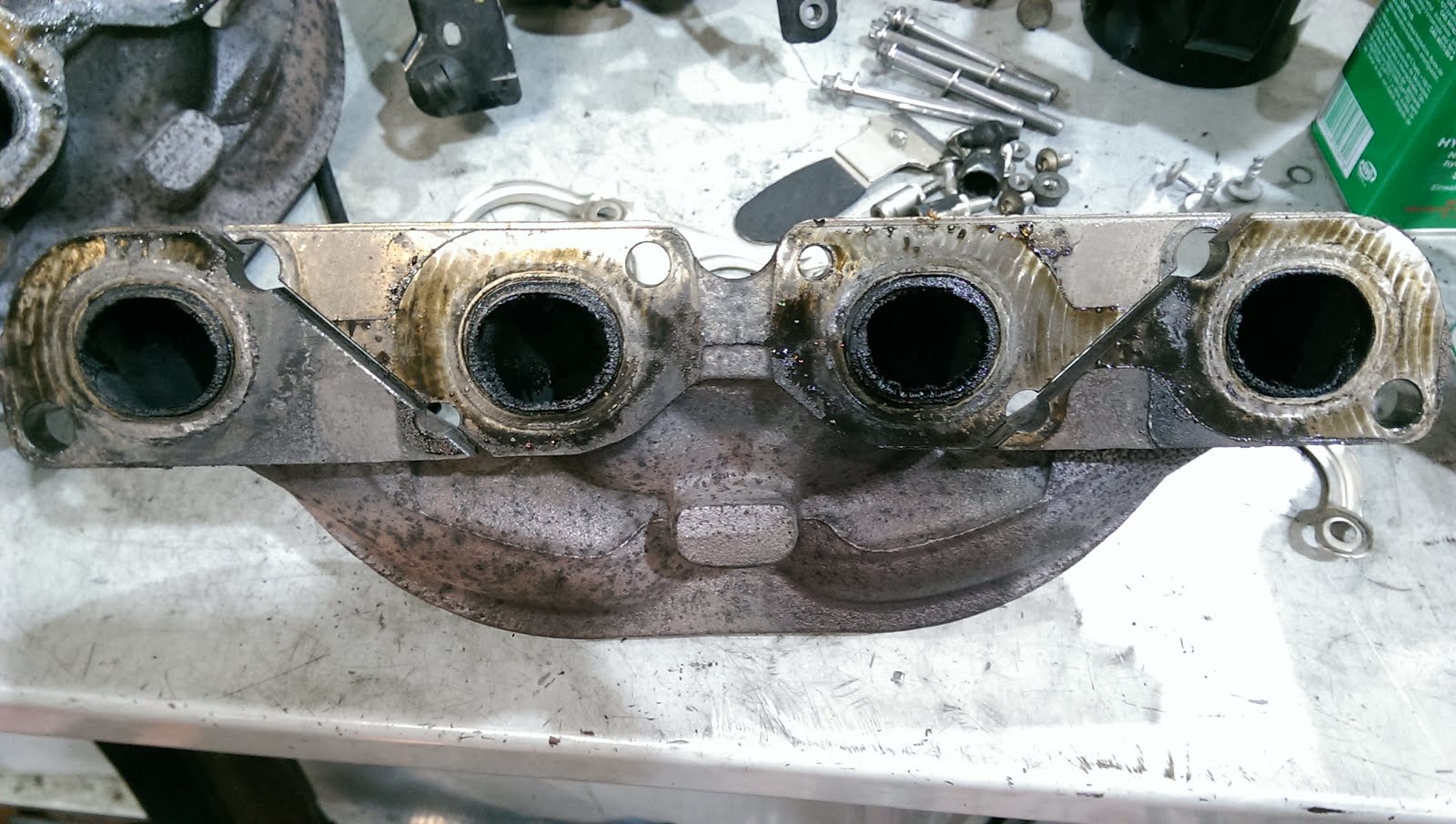
I had to check to make sure that the seals were really leaking, so I removed the turbos and the exhaust manifolds to inspect the valves.


- N63 with turbos and exhaust manifolds removed
This is what I found:


On the left picture you can see the oil had passed through the seals and had entered the intake port. The right picture is of the intake manifold. The oil had been collecting there and also on the intake valves and ports of the cylinder head. After this was confirmed I proceeded with the repair.
On the newer F series platform (F01, F02, F10, F06, F07) the engine is usually not removed from the top. It is lowered, with the transmission and front sub frame on a hydraulic table. The drive shaft, power steering, coolant hoses, fuel lines, etc. are disconnected from the engine and transmission. Then the table is placed under the car and is jacked up. The sub frame and transmission bolts are removed and the complete engine, trans and front sub frame are lowered from the chassis.The vehicle stays up on the lift.

- N63 engine on hydraulic table
After this, the real fun begins. There is a newer way to do this job, which consists of taking the camshafts off and replacing the valve stem seals with the engine and cylinder heads in the car, but when I did this one, the tools to do it this way did not exist, and I had to do it the old way, which is to remove the cylinder heads and place them on a special jig, and then remove the camshafts, lifters, valve springs and finally replace the damn valve stem seals. It sounds like a lot of work because IT IS a lot of work.


On the top picture, we have the bank 2 cylinder head with cover, injectors and high pressure pump. on the bottom picture, the same cylinder head with the valve cover off. Camshafts and vanos units are still installed.


Same cylinder head on the top picture with vanos and camshafts removed. Bottom picture shows part of the engine block after removing the bank 2 cylinder head.


- Close-up picture of one of the cylinders and piston.
After the cylinder head is removed, I also removed the fuel injectors so I could place it on the cylinder head jig to remove the valve springs and seals.

Once the cylinder head is mounted here, the valves are held in place from underneath so the valve spring can be pushed down, and the keepers can be removed. Then the spring can come out to access the valve stem seal.

The spring is compressed by the special tool, exposing the keepers for removal.

This is a picture of the original (red) valve stem seal.

This is a picture of the improved (green) valve stem seal.

Comparison of the old vs new seal. You can clearly tell the old one on top is wider and bowed out compared to the new one on the bottom.

Old seal on left vs new seal on right installed on valve.
After all the dis assembly, I finally get to the valve stem seals. You can see the old one (reddish color) is mushroomed out, causing it to leak and let the oil go through. The new (green) seal fits much tighter around the valve stem, creating a better seal.
Also, since the seals had been leaking for a while, the intake ports and valves were full of carbon so I took the opportunity to clean these to increase airflow.


Valve springs on the back of the pictures. The valves on the left side of the picture are the ones I had already cleaned, compared to the dirty ones on the right.
After cleaning all the valves and ports and replacing the valve stem seals I re assembled the engine and reinstalled it in the car. It ran great after the repairs.
Thursday, June 11, 2015
Stalling E90 M3

Today was one of those days that I was really exited to work on a car. It was an 2011 M3 that intermittently stalls. Another tech scanned it and there were no faults, so they did the usual procedure, which is to reprogram the car with the latest software…the magical fix for everything. Only that this time, when the guy who takes the cars on extended test drives for cases like this drove the vehicle, the engine died twice on him. Sooo, I guess that means it wasn’t the software, huh.
The next step was to ship the car over to me for diagnosis. Curiously enough, another 2011 M3 with intermittent stalling came in the next day, also with no faults stored. Fun times! After a lot of thinking what the fuck could be happening with this thing and theorizing and talking to my team mates on what could be intermittently causing this shit to happen, I decided the best way to go was to chase whatever controls the idle air system. I looked at the training manual and found there is one common controlling device for the idle on both banks, so this would make the most sense, then I noticed the tank vent valve vents into the idle air valve. If the valve stays stuck and vents when its not supposed to, it could cause erratic idling. There are so many things that could be causing this, and the more you think about it, the crazier stuff you can come up with. This is when I need to remember to KISS (keep it simples, stupid) and try the easy stuff first.
So I went ahead and replaced the idle valve and tank vent valve, and so far I haven't heard anything again from the car. It was worth attempting to do the repair after analyzing what may have been going ok. There are many people out there that have the same thing happening to them on the s65 and s85 engines. I would definitely recommend starting with the idle valve/ purge valves. The s85 has two of each. It's expensive, but if you have these cars you need to be able to pay to play.
- Throttle valves, throttle actuators and idle air valve piping


- Idle air valve and piping that goes under throttle valves.


Diesel Power = Torn Harmonic Balancer

 On the left is the original harmonic balancer. On the right is the redesigned one

BMW used to have diesel engines in the USA, until stringent emission laws prevented them from bringing them here anymore. They continued to have them in different parts of the world, and after a lot of work to meet emission regulations, they managed to bring the 6 cylinder diesel engine back to the USA in the E90 and the E70, and let me tell you, they are really powerful. They have so much torque that we've seen a few of the E90s break the harmonic balancer (the big pulley in front of the crankshaft that is used to drive the belt and accessories). When this happens the engine runs but you have no power steering, A/C or alternator to charge the battery. Also, you can smell rubber burning pretty bad. Luckily I've only seen a few of them, and apparently the problem has been corrected by a re designed, beefier harmonic balancer. Now people can enjoy the gobs of low end torque without worrying.....at least about THIS issue. BMW has learned a lot about diesel engines in the USA now and have made drastic improvements on the newer diesels and have now released the 4 cylinder diesels in the USA too. More to come on diesel repairs soon!
- You can see on the old style how the rubber is ripped around the center hub. The hub will spin, but not the rest of the balancer.


- New balancer has a lot more rubber to prevent reoccurrence of the issue.


Subscribe to:
Posts (Atom)